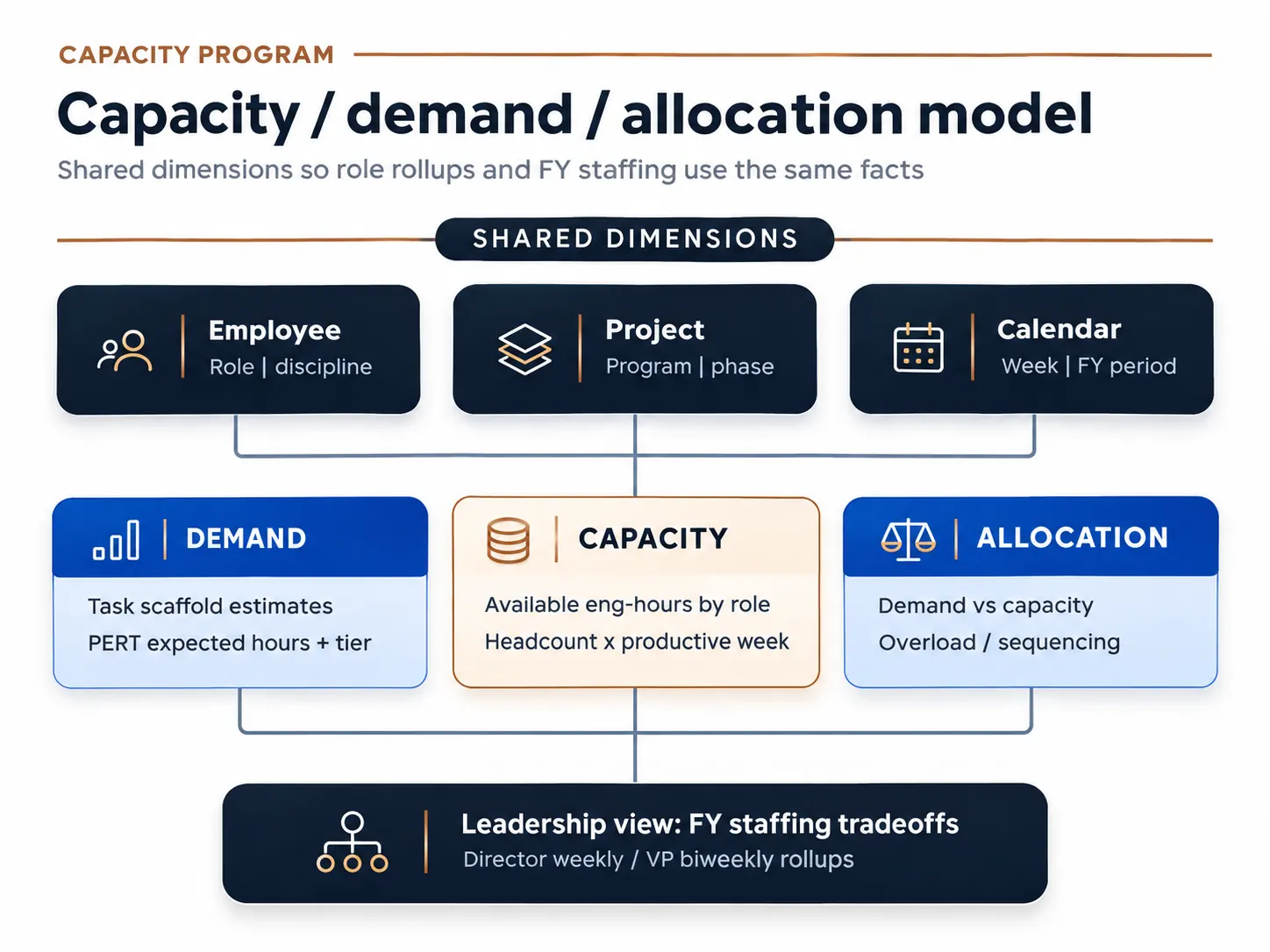
Replaced gut-feel FY staffing with a facilitated capacity system: role × phase task scaffolds, PERT estimates, novelty-tier buffers, and demand-vs-capacity rollups—then led engineering role owners through adoption when no timesheet baseline existed.
Early intake also used level-of-effort and t-shirt sizing (S / M / L / XL) so teams could place demand without fake precision, then deepen the same packages into PERT when staffing or sequencing needed harder numbers.
▣The leadership problem
Fiscal-year capacity decisions were landing on informal impressions. Projects entered planning without reliable task-level hours; engineers could not know all required work at initiation; and no historical time records existed to baseline against. That is not a spreadsheet problem—it is a people and decision problem: role leads need a shared language for demand, uncertainty, and tradeoffs, or leadership will overcommit the same engineering matrix that is already on Multi-Bagger, VAVE, and interface work.
I owned standing this up as a program: design the method, build the artifacts, and lead engineering role owners through adoption so estimates and rollups became a facilitated practice—not a one-off workbook I filled in alone.
◇What I built—and how I led with it
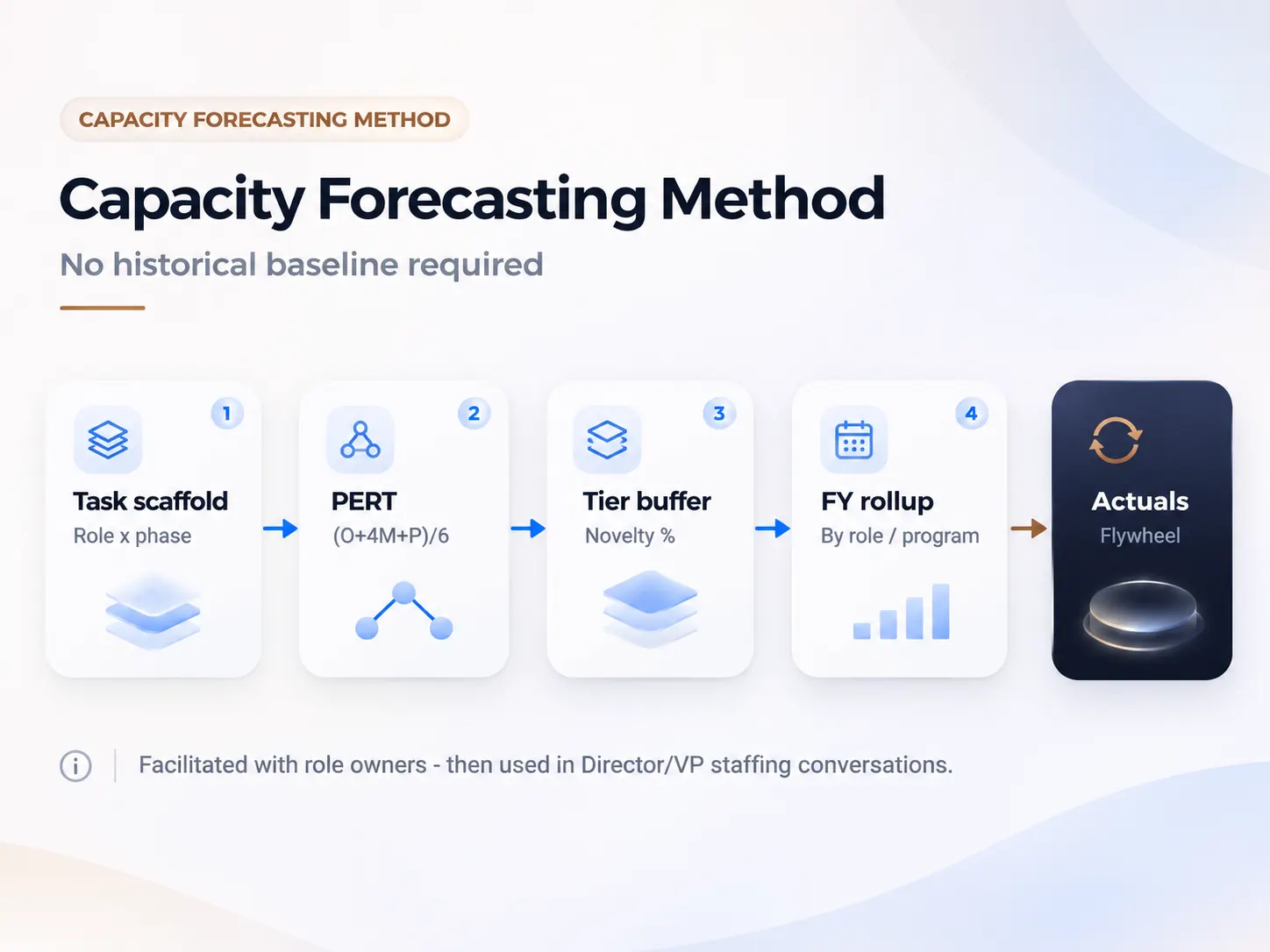
I designed a reusable task scaffold per technical role and product-development phase, then drove optimistic / most-likely / pessimistic estimates with PERT weighting and explicit uncertainty tiers. Totals rolled up by role and program so FY demand could be compared to available capacity in the open.
Before packages were ready for three-point estimates, I facilitated level-of-effort and t-shirt sizing (S / M / L / XL) so role owners could still place demand on the board. The same work packages deepened into PERT when FY staffing or gate calls needed harder numbers—two speeds, one scaffold.
Leadership work sat on top of the method: coaching role owners through first estimates, facilitating sessions where uncertainty was named instead of buried, and bringing rollups into program/leadership conversations so staffing and sequencing decisions had a shared artifact. A calibration loop using future actuals was part of the design so the practice could improve—not freeze as a one-time model.
Engineering Effort Estimator
Adjust optimistic / most-likely / pessimistic hours per work package and pick a novelty tier. Totals update live. Same facilitation logic used with role owners—no historical timesheet baseline required.
POC build & test support
ME / TESTNovelty tier (Contingency)
Applies a planning buffer to the expected effort for all work packages.
Demo only—illustrates the estimating conversation. Full FY rollups and role-owner sessions lived in the deployed planning practice.
Tradeoffs and judgment calls
Replace tribal load with a shared demand model. FY staffing could not stay as informal impressions. Role owners estimated with uncertainty visible—so leadership could see overload before committing the same matrix to Multi-Bagger, VAVE, and interface work.
Scope of planning depth vs forecasted need. Scaffold and rollup fidelity were sized to decisions Directors/VPs actually make (demand vs capacity, sequencing)—not infinite WBS perfection. Uncertainty tiers made “we don’t know yet” a first-class input instead of silent schedule optimism.
LOE vs PERT fidelity. T-shirt / level-of-effort sizing was enough to sequence and flag overload early; three-point PERT was reserved for packages that drove staffing or gate calls.
Tools & operating systems I put in place
Program systems people used in facilitated estimating—not demos.
Role × phase task scaffold
Reusable WBS so each technical role owned a comparable estimate surface across programs.
PERT + uncertainty-tier sessions
Led estimating conversations where optimistic/likely/pessimistic and novelty buffers were explicit.
Capacity rollup reviews
Brought demand-vs-capacity views into leadership tradeoffs instead of leaving load invisible.
Actuals calibration loop
Feedback path so future estimates could improve from real delivery data.
LOE / t-shirt intake
S / M / L / XL scoping so demand could land before packages were ready for three-point PERT.
Key learnings
Repeat
Facilitate the estimating conversation—don’t fill the workbook alone. Role-owner ownership is what turns a method into a decision system Directors can trust.
Do differently
Stand up the actuals calibration loop in the same quarter as first rollups. Without early feedback, buffers stay heuristic longer than they need to.