▣Product context
iA’s Smart SecurePack – Multi is a fully automated bagging product for high-volume pharmacy fulfillment. It consolidates multiple prescriptions for one patient—up to roughly five bottles per bag—while printing, folding, and inserting paperwork, then integrating into the broader automation line and NEXiA-orchestrated workflow.
Internally the NPI effort was known as Multi-Bagger. I owned the program: sequencing engineering and production builds, introducing readiness reviews and manufacturing handoffs, and keeping execution aligned with customer commitments and schedules.
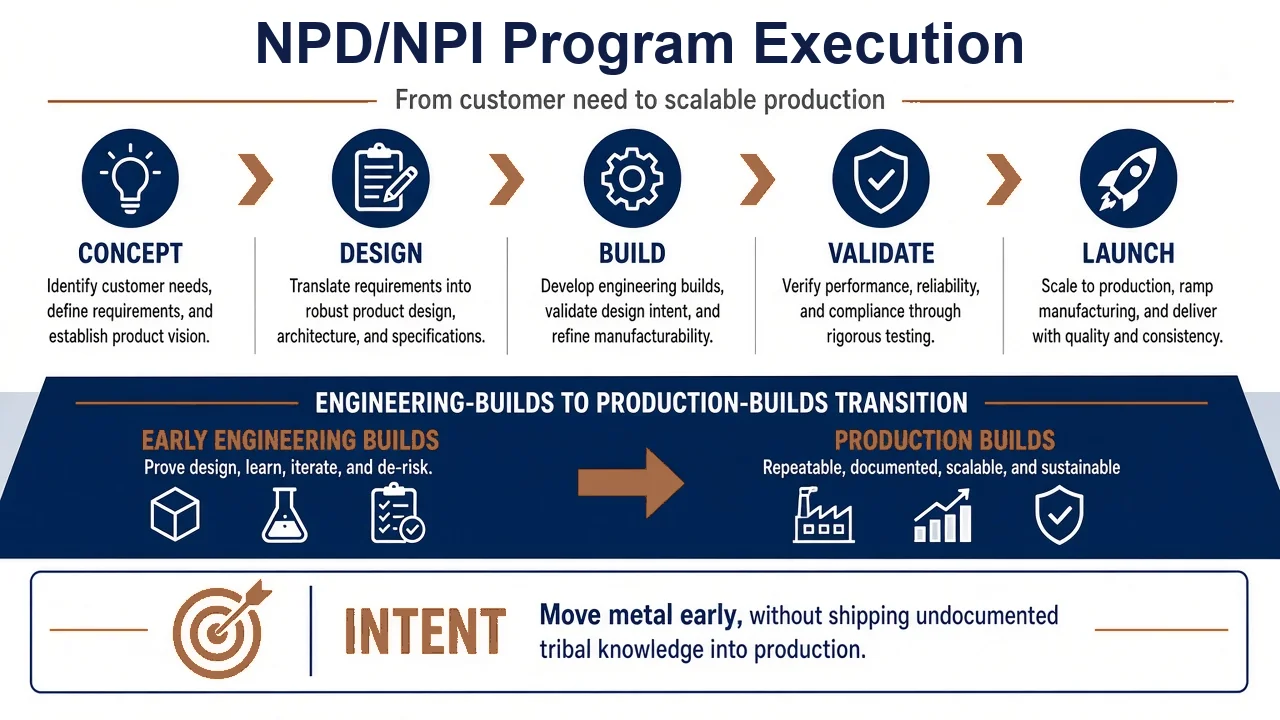
◇Engineering builds into production builds
The build strategy put early customer-bound units under Engineering control, then handed subsequent units to Production. That got metal moving early, but it required a deliberate handoff so manufacturing inherited prototype learning instead of undocumented tribal knowledge.
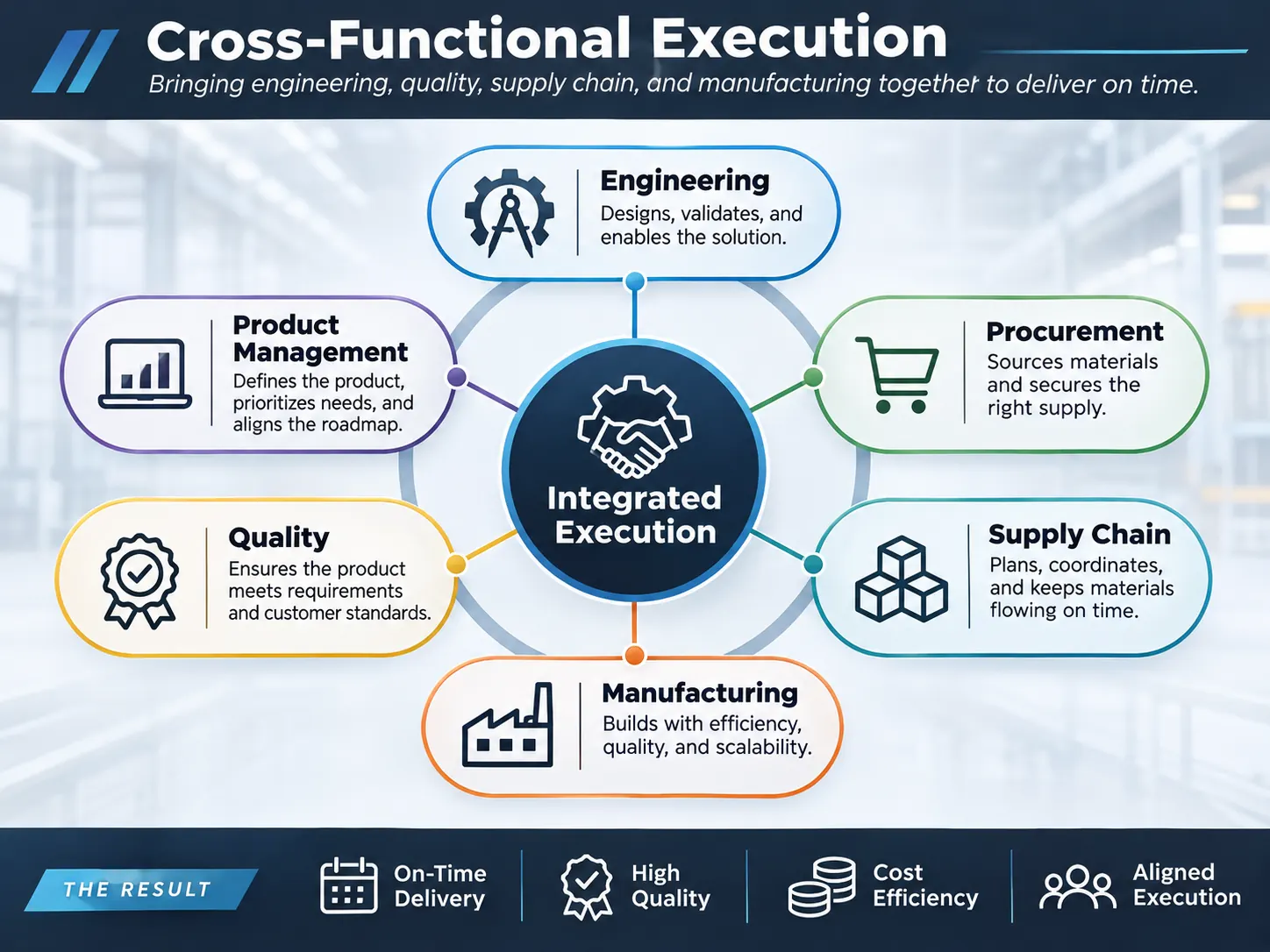
Across mechanical, electrical, software, supply chain, quality, and operations partners—roughly a 20–40 person matrix—I drove the forums and artifacts that made readiness visible.
⬡Materials and deviation control on the critical path
At the engineering readiness review, most parts were stocked—but outstanding critical fabricated parts still blocked any honest pull-in of the build date. Some bulk orders had also limited normal first-article inspection coverage, adding conformance uncertainty.
The team agreed on daily engineering standups, part-deviation red-tag handling, whiteboard issue capture into Smartsheet, and a structured nonconformance log. I built and distributed the tracker and later coordinated the manufacturing handoff.
◎Commissioning under constraint—and the outcome with limits
Dedicated test equipment and resources were limited, so the plan was to commission the first build against machine-level design requirements and use those results to shape later units. Build-time cycle measurements were deferred early—trading early timing data for capacity to stabilize the physical builds.
Later assessment reported delivery in line with the customer Operations schedule, while product and operational readiness items remained open. A successful engineering-build handoff mattered; it was not the same as claiming every general-availability milestone closed.
Tradeoffs and judgment calls
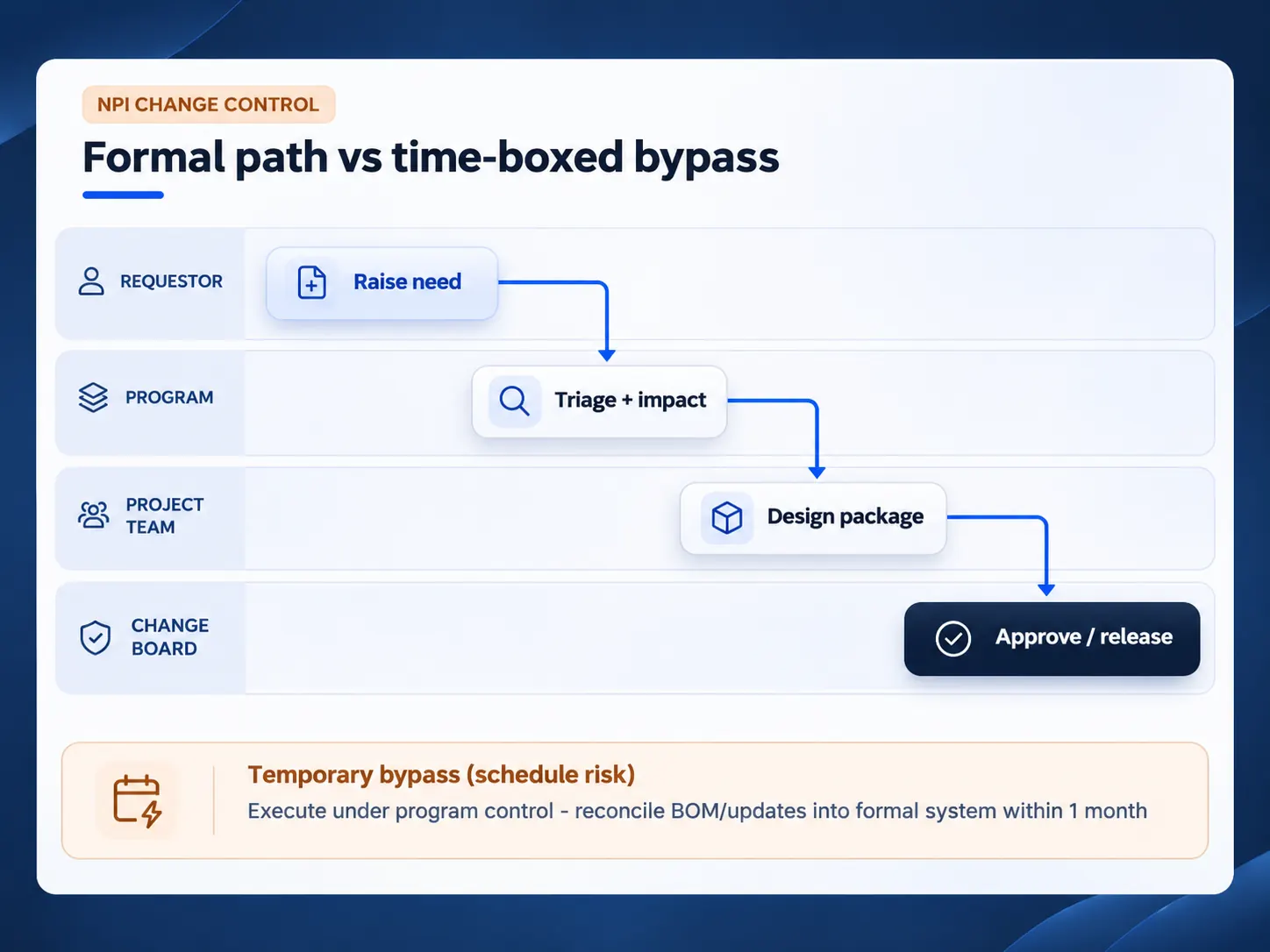
Protect the customer schedule with a time-boxed configuration path—then reunify into formal control. When formal change-cycle turnaround threatened the critical path, we kept deadline-bound builds moving under explicit program control, with a dated commitment to reconcile BOM and updates back into the control system.
Mitigations (so speed was not cowboy engineering): increased documentation of changes and lessons learned; daily standups; and weekly BOM reviews to capture deltas until formal reconciliation. Director/VP saw the tradeoff explicitly: schedule risk vs control-system latency—with a dated reunification plan, not an open-ended exception.
Readiness still constrained the work. Materials and FAI reality still gated honest pull-ins; the time-boxed path bought execution bandwidth against customer deadlines without pretending configuration control could be abandoned permanently.
Executive reporting: this program—like every active hardware program—ran with a risk/dependency register and active-program health into Director weekly / VP biweekly reviews.
Tools & operating systems I put in place
Program systems that made readiness and handoffs real for a ~20–40 person matrix—not slideware.
Engineering readiness reviews
Formal gates for materials, deviations, and go/no-go before pretending the schedule could move.
Deviation / nonconformance tracker
Red-tag path into Smartsheet so prototype issues had owners instead of whiteboard fog.
Daily standups + weekly BOM reviews
Mitigation cadence during the time-boxed path—captured changes until BOM reconciliation.
Dated control-system reconciliation
Plan to reunify BOM/updates in the control system after the customer-schedule window.