Framework case study Thoughts & examples
Hardware Engineering Organization Design: A Better Model
Why engineering organizations should rethink product ownership, capacity planning, and lifecycle supportand why one structure will not work for every manufacturer.
In short: Prefer stable, product-aligned engineering ownership with deliberate capacity reserved for development, sustaining, and portfolio improvementplus formal lifecycle handoffswhile letting team depth and sustaining mechanisms vary by product complexity, customization, and manufacturing volume. Try the interactive model in this article ↓
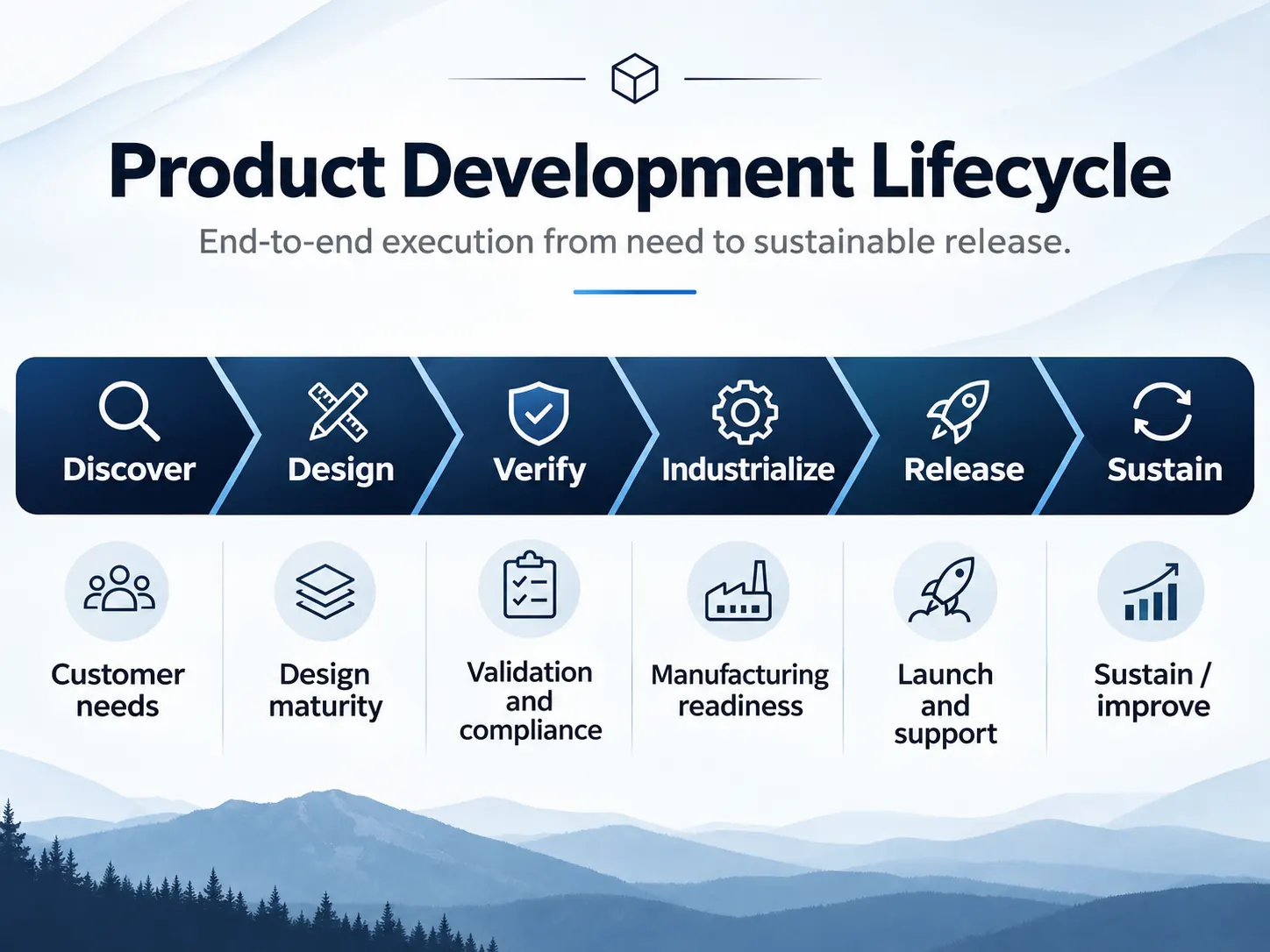
Hardware engineering has refined how products get to market. Stage gates, design reviews, integrated schedules, configuration control, validation, and manufacturing readiness are familiar tools. Many organizations still struggle with a more basic problem: the same engineers charged with building tomorrows products are also expected to keep yesterdays products alive.
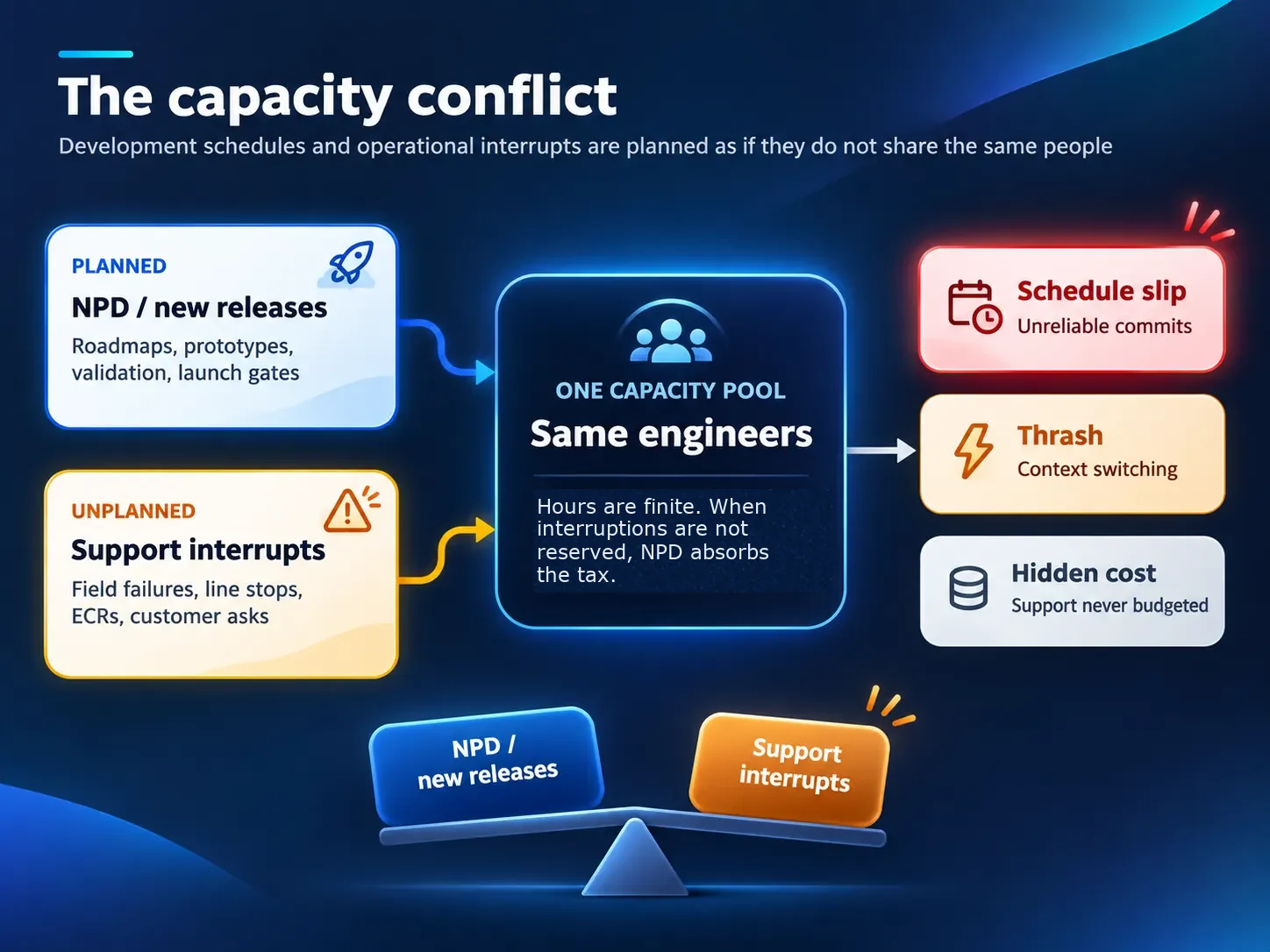
On any given week, an engineer on a new release may also be troubleshooting an installed system, clearing a manufacturing stop, processing a change order, or answering an unexpected customer requirement. All of that work is real. The failure is planning it as if it were not competing for the same people.
When development slips, leadership often reaches for better project management, harder accountability, or tighter execution. Those can help. The more consequential question is whether the engineering organization is structured to deliver the work it has already promised.
What is a hardware engineering operating model?
A hardware engineering operating model is how an organization assigns product ownership, allocates engineering capacity, and transfers accountability across development, NPI, manufacturing, installation, sustaining, and field support. Process excellence without that model still leaves schedules competing with unplanned work.
What can hardware learn from software team design?
Mature software organizations offer a useful comparison, not a template. Many run stable teams with clear product ownership, prioritized backlogs, regular planning cadences, and explicit paths for production support. They still face interruptions, competing priorities, technical debt, and incidents. What they get right more often than hardware is the operating logic: ownership is named, capacity is reserved, and support is not treated as free work that somehow fits around the plan.
Hardware can adopt those principlesstable teams, deliberate capacity allocation, consistent collaboration, clear ownershipwithout copying sprint rituals. Physical development has different constraints. Parts must be sourced, prototypes built, tooling developed, systems integrated, and validation performed in the real world. Regulation, capital equipment, specialized labor, and manufacturing introduce dependencies that do not map cleanly onto two-week cycles.
The opportunity is not to turn hardware into software. It is to bring the same seriousness to how engineering work is organized and how capacity is committed.
When should manufacturers use product-aligned teams?
Many hardware organizations still run as classic functions. Mechanical, electrical, firmware, systems, and validation report through their disciplines and get assigned to projects as needed. That model protects expertise, standards, and sharing of scarce skills. It also fragments product accountability and turns every program into a fight for the same people.
A stronger patternwhen ownership is unclear and support continually interrupts developmentis stable, product-aligned teams inside the broader engineering organization. Those teams hold clear technical responsibility for a product or product family, with known assignments and a predictable planning rhythm. Functional leadership still matters. Engineers across products should meet regularly to share design practice, work hard problems, and find reuseworking sessions, not another status forum.
Product alignment does not mean every product gets a permanently staffed, fully independent team. The right structure depends on the business you are actually in.
Does manufacturing volume alone determine engineering structure?
No. A company building a handful of highly complex systems and a company shipping thousands of similar devices both need development, manufacturing, quality, and sustaining engineering. Their operating models should not look the same.
Low-volume, high-complexity products
These often need specialized multidisciplinary teams that stay close through integration, commissioning, and early operation. Each system carries high technical and financial exposure. A failure may demand deep investigation, and original design knowledge can remain essential for years.
Low-volume, highly customized products
Engineering adapts a common platform to customer layouts, controls, interfaces, performance targets, or operating conditions. It often makes sense to separate core product engineering from applications or customer-specific engineering: one owns architecture and the standard design; the other owns approved adaptations, integration requirements, and deployment-specific work.
High-volume, standardized manufacturing
Engineering demand is driven by aggregate patternsdefects, process capability, supplier quality, yield, reliability trends, and design changes that hit large populations. Treating every issue as a unique engineering project is expensive and slow. Structured quality systems, statistical analysis, manufacturing engineering, and corrective-action processes should carry more of the load.
High-volume, configurable products
Large volumes of a common product with many options mean complexity follows configuration as much as unit count: change impact, option compatibility, test coverage, and traceability.
Many manufacturers run several of these models at once. That is why a single enterprise team structure rarely works. Better practice is common governance and accountability, with product groups free to use operating mechanisms that match their manufacturing and support reality. Use the interactive model below to see how environment, headcount, and unplanned work change the suggested design and weekly capacity picture.
Interactive demo
Engineering Operating Model Lab
See how product environment, capacity, and workload shape your operating model.
How should NPD and sustaining responsibilities be separated?
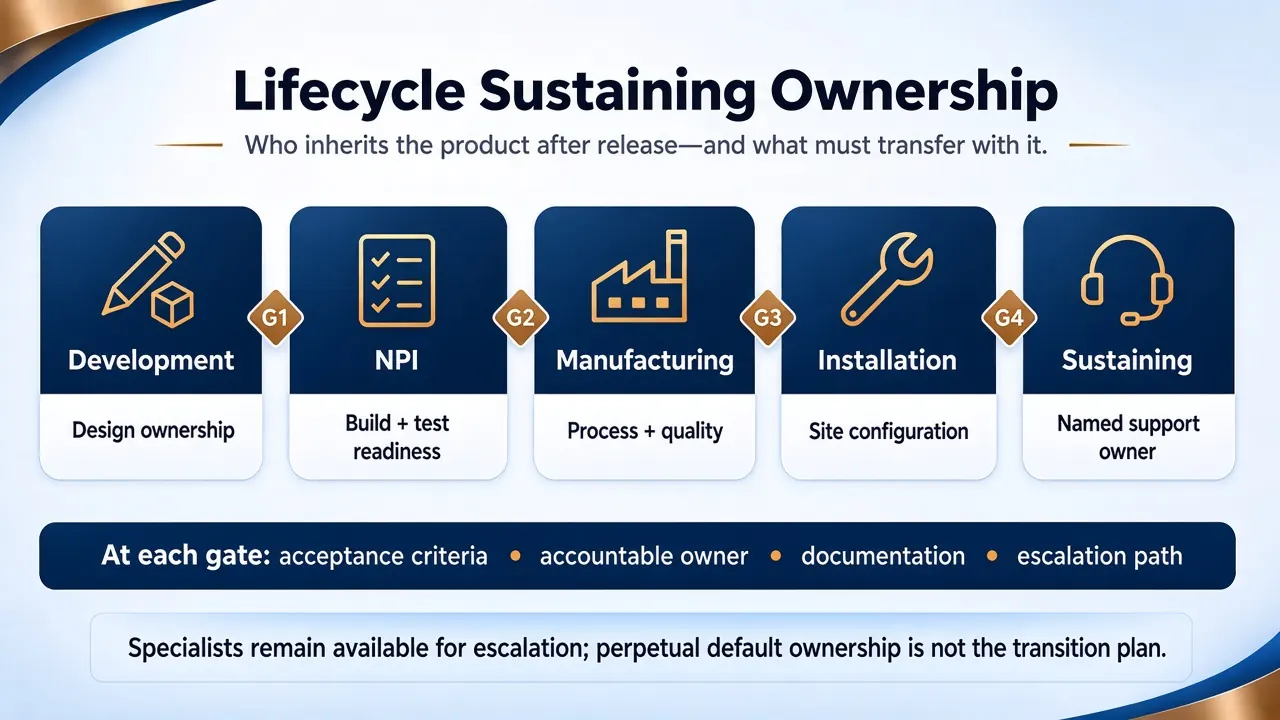
Regardless of production model, one principle should hold: responsibility for a products operational life must be designed before development ends.
Too often the handoff into sustaining and field support is informal. Validation finishes, manufacturing starts, shipments beginand development engineers remain the default escalation path because they know the system. That becomes an indefinite support tax on the next development assignment.
Development plans should include formal lifecycle transition checkpoints. Manufacturing, quality, sustaining engineering, field support, and customer operations need to be involved early enough to shape design and prepare for what they will inherit. Stage gates should test operational readiness, not only technical readiness.
Before ownership transfers, the receiving organization should have documentation, configuration records, diagnostics, training, support channels, and a clear view of open issues. A formal transition notice can then state support status, effective ownership date, responsible group, contacts, escalation paths, and any remaining development obligations. That does not cut development off. It defines who owns day-to-day support and how specialists stay involved when needed.
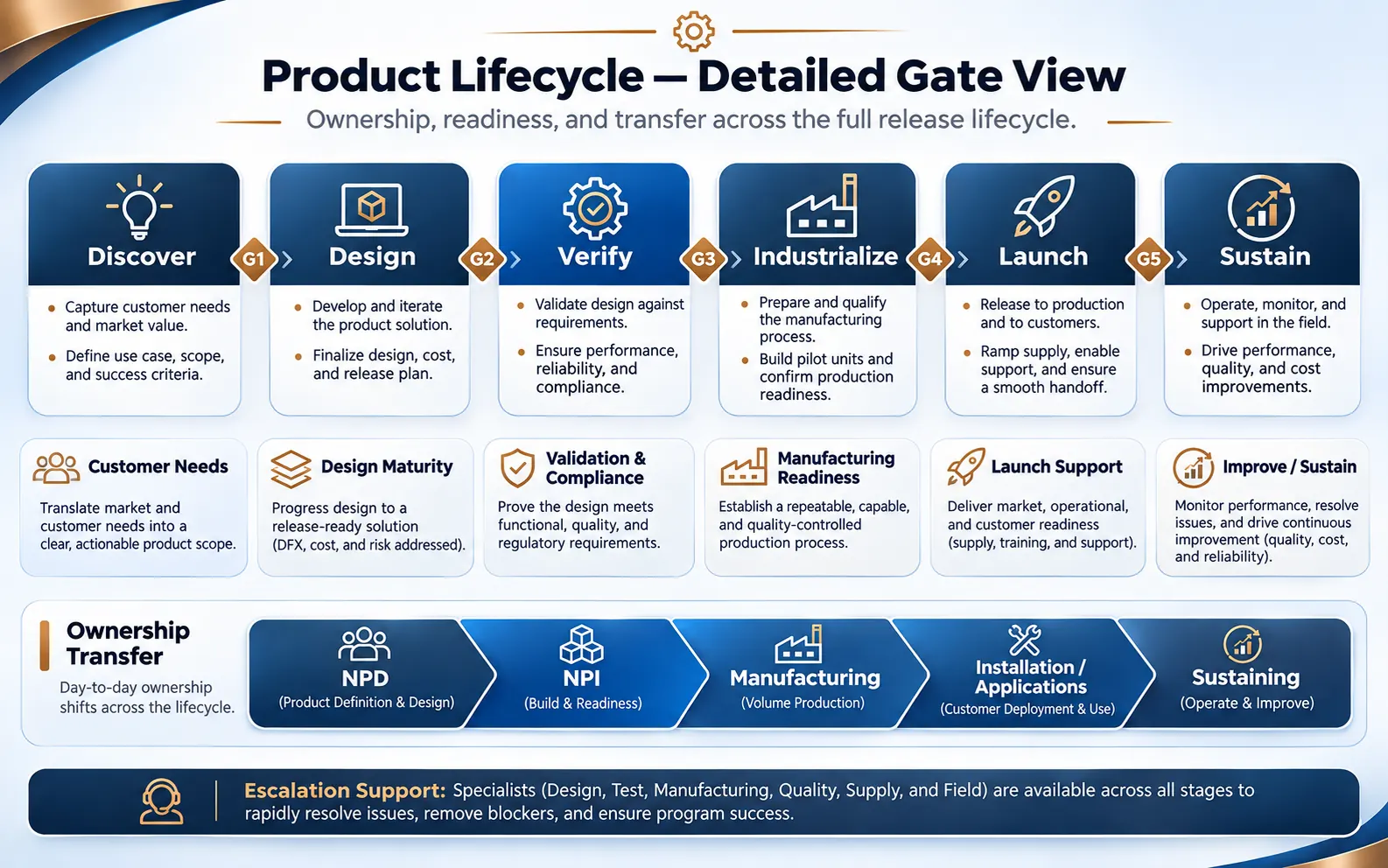
For customer-configured systems, separate the transitions. A standard machine can be ready for production while a specific installation still needs integration, site acceptance, or configuration-specific validation. Those are different ownership problems; treat them that way.
How should sustaining capacity reflect product economics?
Sustaining is not a fixed headcount category. It should follow how the product actually fails, ships, and gets serviced.
A complex low-volume system may need a small pool of specialists who know its architecture and failure modes. A high-volume product is often better served by reliability engineering, manufacturing quality, field-failure analysis, and systematic corrective action. Customer-configured equipment may keep applications engineering in the loop through deployment and later configuration changes. A mature family with shared architecture may be supported by one sustaining team across related products rather than duplicated expertise per SKU.
Support demand is shaped by complexity, volume, configuration diversity, installed-base size, reliability, and service model. A useful operating model responds to those factors instead of imposing one sustaining template everywhere.
What is the hidden cost of unplanned engineering work?
Organizations chase lower warranty cost, fewer service visits, and less manufacturing rework. Improving those outcomes usually requires engineering: investigation, redesign, better diagnostics, permanent corrective action, supplier qualification. When that capacity is not reserved, the work does not vanish. It lands on people already committed to development.
The result is familiar: chronic operational issues, interrupted design work, unreliable schedules, and delayed product improvements. What looks like a headcount saving is often a cost transfer into schedule slip, field pain, and lost engineering focus.
Leadership should make three buckets visible and intentional: capacity to create new products, capacity to maintain existing ones, and capacity to improve the economics of the installed portfolio. When operational demand rises, the impact on planned development should be an explicit tradeoff-not an assumption that commitments still hold. That is portfolio investment, not just resource planning.
Can one governance model support different execution models?
Yes. A mature hardware organization does not need every product group to run identically. It needs shared principles that create accountability and predictability across different environments: clear product ownership, realistic capacity planning, planned lifecycle transitions, controlled engineering change, transparent priorities, and recurring cross-functional collaboration.
The mechanisms underneath can differ. An aerospace subsystem team may plan around technical maturity, integration events, and heavy validation. An industrial automation group may plan around platform releases, customer configuration engineering, manufacturing readiness, and site acceptance. A high-volume electronics manufacturer may organize sustaining around process capability, failure analysis, reliability trends, and high-throughput corrective action. All of that can sit inside one enterprise framework without identical staffing models or cadences. Cross-product cadence keeps functional depth alive without dissolving product ownership.
How should organizations start without adding bureaucracy?
Formalizing these practices carries real risk. Extra teams, reviews, and gates can harden into bureaucracy. Rigid ownership can kill collaboration. Dedicated product teams can waste scarce expertise when workloads swing. The answer is not a wholesale reorganization on day one.
Start with evidence. How much planned development is displaced by unplanned support? Which products generate recurring engineering demand? Which issues require rare expertise? Where are ownership transitions unclear? Which groups would benefit from stable assignments instead of temporary sharing?
Those answers can drive changes grounded in how work actually consumes people. Hardware organizations have spent decades refining how products are developed. The next leverage point is applying that same discipline to how engineering teams are owned, supported, and deployed.
The most effective hardware engineering organization is not the one with the fewest people or the most uniform structure. It is the one that aligns technical ownership and engineering capacity with the real demands of its productsthrough development, manufacturing, deployment, and the years of operation that follow.
FAQ: hardware engineering organization design
What is a hardware engineering operating model?
It is the combination of team structure, capacity allocation, product ownership, and lifecycle handoffs that determines how engineering work is planned and delivered across development, manufacturing, deployment, and sustaining support.
How should NPD and sustaining engineering responsibilities be separated?
Plan lifecycle transition gates before development ends. Transfer day-to-day support with documentation, diagnostics, training, and escalation paths, while keeping development available for specialized expertisenot as the default first line.
When should a manufacturer use product-aligned teams?
When functional pooling leaves product accountability unclear and support continually interrupts development schedules. Keep cross-product technical forums for standards and reuse; size team permanence to complexity and volume.
How does high-volume manufacturing change the structure?
Sustaining shifts toward aggregate quality, process capability, reliability trends, and corrective action. Configuration-heavy high-volume products also need strong variant/compatibility ownershipnot only unit-volume thinking.